
You are using an out of date browser. It may not display this or other websites correctly.
You should upgrade or use an alternative browser.
You should upgrade or use an alternative browser.
Worth Watching if you have a Ecoflow Power Kit
- Thread starter wildebus
- Start date


GeoffL
Full Member
- Messages
- 929
FWIW, I was horrified when I saw that. Wouldn't have been so bad if the cables had actually been properly joined -- but that on a high current application?...

This could be a huge problem for some builders as that cable could well be tied in place before construction of cabinetry structure and so might need dismantling most of one side of the habitation area as work in way to replace it.I have removed my product review video because of what John has discovered.
This is inexcusable, and I expect a product recall of the cables.

QFour
Full Member
- Messages
- 297
They should be ashamed of themselves that is no way to join cables. Somone realised if you just wound them together you would notice the bulge in the cable. No reason to join cable really unless they are trying to save money. I would certainly take it further. I do wonder how many more are out there. Its not a one off someone thinks they know what they are doing.
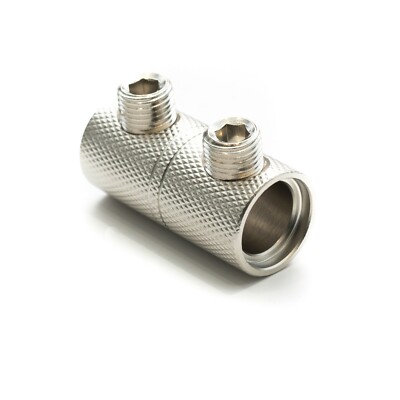
25mm² 4 gauge heavy duty barrel splice cable high quality machined connector | eBay
This item will include 2x 25mm ferrules and heat shrink.
www.ebay.co.uk
Last edited:


mistericeman
Full Member
- Messages
- 796
To be honest ....I've seen far worse from people that have built their own ...Thank heavens I built my own van electrics, that just is so bad, id be looking compo for stress.
Electrics/gas and diesel heater installations that would make your eyes itch .

trevskoda
Full Member
- Messages
- 6,373
Very true, had some turn up at my door would scare the living daylights out of you, some folk should not be let loose.To be honest ....I've seen far worse from people that have built their own ...
Electrics/gas and diesel heater installations that would make your eyes itch .

wildebus
Full Member
- Messages
- 7,922
I remember when I did my first camper, the split-charge cable ended up being around 6" or something too short. So frustrating and what a faff it always is to join heavy (or even heavy-ish) cable.
Ever since then, I err on the side of excess and usually end up having to chop a couple of metres off each length once routed. It is far easier to make a cable shorter than it is to make it longer!
Ever since then, I err on the side of excess and usually end up having to chop a couple of metres off each length once routed. It is far easier to make a cable shorter than it is to make it longer!


jagmanx
Full Member
- Messages
- 3,031
Yes, and Barbers don't cut hair any longer !I remember when I did my first camper, the split-charge cable ended up being around 6" or something too short. So frustrating and what a faff it always is to join heavy (or even heavy-ish) cable.
Ever since then, I err on the side of excess and usually end up having to chop a couple of metres off each length once routed. It is far easier to make a cable shorter than it is to make it longer!

trevskoda
Full Member
- Messages
- 6,373
I used battery cable fused at both ends, ran it through the floor along the chassis to a old diode split charge junction box behind the engine on the bulkhead, when I start the engine I flick a switch which opens a 200ah relay connecting the les batts to the starter batt which is being charged from the alternator, if I forget the batteries is still getting 13.7 through the old diode sys, voltage meters on the dash dont let me forget.

CriftinsCampers
Full Member
- Messages
- 432
Hopefully just a one off. Motorcraft have recently had a Roamer battery fire and that has unfortunately become a bit of a bun fight between them and Roamer on FB.
Faults occur for the most obscure reasons and in the case of that badly bodged cable splice it could just as easily have come off the cable drum like that.
No pfy in some sweat shop would have been allowed let alone empowered to take the time to check a splice covered in HS.
Faults occur for the most obscure reasons and in the case of that badly bodged cable splice it could just as easily have come off the cable drum like that.
No pfy in some sweat shop would have been allowed let alone empowered to take the time to check a splice covered in HS.
wildebus
Full Member
- Messages
- 7,922
I don't know if I could agree with that.Hopefully just a one off. Motorcraft have recently had a Roamer battery fire and that has unfortunately become a bit of a bun fight between them and Roamer on FB.
Faults occur for the most obscure reasons and in the case of that badly bodged cable splice it could just as easily have come off the cable drum like that.
No pfy in some sweat shop would have been allowed let alone empowered to take the time to check a splice covered in HS.
I think it is very unlikely a cable join like that would be on a roll of cable - you have the cable and it has the insulating sheath on and that is what you get on a cable roll. To join a cable the sheath would need to be cut back for the join and then recovered by 'something' (and something a lot more substantial than heat shrink). This would be very evident when the cables were pulled off the roll to be cut to length.
So #1 - if for some reason the cable supplier HAD supplied a cable like that (which is very unlikely), the people making the cable lengths would have noticed it and either rejected that drum - or more likely removed that section and cut a fresh length.
It is possible that the copper cable was joined prior to the process that applies the insulation sheath over it I suppose but I would again find that very hard to believe. It would be more work that is worth while when making 100M drums of cable to start joining cables. And again the join would have been very obvious with a bulge - which itself if seen in a cable coming off a roll would be a cause for alarm for anyone working with it. Even just a twist on a heavish cable on a roll makes an odd bulge which won't go un-noticed (and probably cut out when making a cable. I would/do).
The fault will clearly be with the company who are making the actual end-to-end cable of length of maybe 10M at the very most (and more like 5M probably) cutting lengths of perfectly ok cable from the drums, and in this case instead of getting a new drum when the old one was short, jojning it with another left-over piece to make the required length. In a production environment it is a remarkable thing to do as doing this is actually far less efficient time-wise then getting a new - correct - length of cable.
As far as I can see there is only one company that is to blame for the production of a cable as shown in the video - and that is the one that makes the finished cables with the end connectors on and the braiding put on.
Any part of the process before that, a cable join like this would have been extremely obvious.
Any part of that process after that, the join would have been hard to spot.
Last edited:
GeoffL
Full Member
- Messages
- 929
Gadget John has posted an update that confirms @wildebus 's note that it was the manufacturer of the cable, not Ecoflow, who messed up. He takes pains to say that, other than that cable, Ecoflow make good stuff. However, he's still ripped out the Ecoflow system and is in the process of fitting Renogy...

Geek
Full Member
- Messages
- 1,087
He bought the cable as part of an Ecoflow "plug and play" kit.Gadget John has posted an update that confirms @wildebus 's note that it was the manufacturer of the cable, not Ecoflow, who messed up. He takes pains to say that, other than that cable, Ecoflow make good stuff. However, he's still ripped out the Ecoflow system and is in the process of fitting Renogy...
It makes no difference who made the cable: it was something he bought from Ecoflow, branded as Ecoflow and dangerously defective.
In addition, the cable was under specified for the job and he had lots of other issues with the Ecoflow kit