merl
Full Member
- Messages
- 380
Nice!It kick out about 70amps
Does that alter much with battery SOC?
What gauge cable you using between batteries?
What length approx?

Nice!It kick out about 70amps

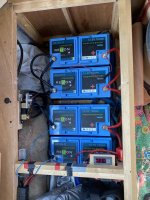
Cheers, what's the distance and cable gauge for the charging circuit, ie between the lithium and the cab battery/alternator?It's about 1m from inverter to batteries and I upgraded to 70mm cable as the 35 mm was getting warm not hot just warm .Have 4 batteries I use 70mm to connect them all together the cables between the batteries are only about 350mm long

They are good Combiners. Installed one in Raes new campervan. Not ideal for one with a smart alternator but it works fine with a simple workaround.Possible 5m and I thinks it's 35mm cable split charger at lithium end its what Phil tells me to use as I've know idea lololol.Had this set up for about 5 years
If you've dropped in 4X100Ah lithiums in parallel and cabled them back to the the alternator/starter battery with 35mm cable and you get a nice sensible 70A charge current it just demonstrates that burning out your typical MH alternator by dropping in a lifepo4 without a B2B isn't going to happen in reality. Much more likely to get insufficient charge current with a lithium 'drop in' and the typical cable gauge you'd experience on a standard MH.Possible 5m and I thinks it's 35mm cable split charger at lithium end its what Phil tells me to use as I've know idea lololol.Had this set up for about 5 years
I asked Phil about a battery to battery charger but he said I didn't need one .If you've dropped in 4X100Ah lithiums in parallel and cabled them back to the the alternator/starter battery with 35mm cable and you get a nice sensible 70A charge current it just demonstrates that burning out your typical MH alternator by dropping in a lifepo4 without a B2B isn't going to happen in reality. Much more likely to get insufficient charge current with a lithium 'drop in' and the typical cable gauge you'd experience on a standard MH.
ive never had the battreies down to 20% lol as for what happen at 90% ive never looked all i know it works ok with know probs.I've commented many times about charging lifepo4 without a B2B, I wouldn't advocate it for everyone but with the correct wiring it'll be more than adequate for many installations.
Have you ever taken the time check how the charging current changes with a heavily discharged battery, say below 20%? And again what happens re the charge current when you reach 90% capacity?
I'd expect there to be a considerable difference.
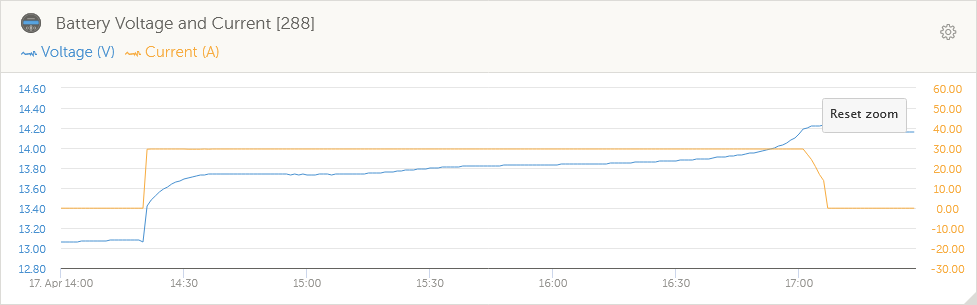
Actually, there should be virtually no difference. A lithium battery charges at full current from zero SOC all the way to 100% SOC.I've commented many times about charging lifepo4 without a B2B, I wouldn't advocate it for everyone but with the correct wiring it'll be more than adequate for many installations.
Have you ever taken the time check how the charging current changes with a heavily discharged battery, say below 20%? And again what happens re the charge current when you reach 90% capacity?
I'd expect there to be a considerable difference.

hi, I have done just this. 2005 Autotrail Chayenne on a Fiat base.I’m doing up a 1993 vw t4 Autotrail Cherokee , inc replacing the entire electrical system.
I had planned on using an 20 amp dc to dc charger and 2 x 100 lithium batteries with 450 w solar and 2000w inverter.
However Black Friday and see Renology has 3000w inverters at a good price, what sort of input would I need into a 3000w inverter?
Could I run 12v ? Don’t think the old alternator which is around 65 amp output would handle any more than an 20 amp dc to dc charger?
I used to think exactly the same David but I'm sure I got it wrong. Rather than thinking about the lithium battery 'sucking everything it can' and burning out/ stressing components, instead consider what happens to the voltage measured at the battery in various situations.this is why it is such a bad idea to consider Lithium as "drop in replacements" on vans with low capacity split-charge systems as the stress potential is too large for comfort.
Sure, I agree IF the load is actually increased. How is the load being increased though? It CAN'T be increased simply by drop in lithium David because ohms law proves that alternator current must goes down.and the load increased.
All I can tell you is what I see. I think you are missing a fundamental point but as I said, everyone is entitled to their own view. What I have seen tells me no thanks.Sure, I agree IF the load is actually increased. How is the load being increased though? It CAN'T be increased simply by drop in lithium David because ohms law proves that alternator current must goes down.
Yes Neil, massively.Would there not be some listing by the gauge of cable used?
In a properly fitted install the wiring will already be suitable for charging a LA battery from the alternator. As I've already pointed out the higher LFP battery voltage will result in LESS current than LA so further limiting of current (by adding wiring resistance) will simply make things worse, it's not needed so it's a moot point.What I also think is a poor idea is using thin cabling to provide current limiting by regarding it as controlling current through resistance. That is just a problem waiting to happen.
So you are saying that if you swap a lead battery for a lithium one, the charge current will actually go down?In a properly fitted install the wiring will already be suitable for charging a LA battery from the alternator. As I've already pointed out the higher LFP battery voltage will result in LESS current than LA so further limiting of current (by adding wiring resistance) will simply make things worse, it's not needed so it's a moot point.