240v hook up battery charge.

I've bought a smart charger for vehicle battery, I can turn the hab battery charger off independently so its no big deal.
The problem was the vehicle battery not being maintained which I've done what Wildbus said, just with a more in budget smart charger.
It's a 07 plate moho, so I fully understand its not going to have the most modern or best quality equipment on it.
Thanks for your help.
I have 400watts of self installed solar although a 100watt to 200watt would work. The solar is great as it tops up the battery and keeps the load off when using 12v systems like pump and TV so there is always some power in the tank. Which is not so important if you go to sites on EHU so your best option is a smart charger plugged in.
 
No it will not charge as part of the mains hookup. Using EHU to charge your leisure battery is not very efficient and can shorten the life of your leisure battery as it is not a smart charger it’s a power supply that just outputs the same voltage no matter how much the battery is charged. You can either use a smart charger plugged in or use a solar panel connect the vehicle battery to the leisure battery via a box to divert the solar charged leisure battery to the vehicle battery
I never realised this, thanks for pointing it out. In future I will only charge hab battery as required and not leave it on all time with elec hook up. I did wonder what the point of the charge on / off switch is but it makes sense now.
 
I have 400watts of self installed solar although a 100watt to 200watt would work. The solar is great as it tops up the battery and keeps the load off when using 12v systems like pump and TV so there is always some power in the tank. Which is not so important if you go to sites on EHU so your best option is a smart charger plugged in.
I am planning to fit solar panels but not got round to the research on what to fit yet.
I am very practical and good with hand and electrical work doesn't phase me but I've no great experience with Moho related stuff as last year was our 1st full year of ownership.
Moho also has a few angles to roof and 4 skylights and an aerial so I'm going to have to be clever with using the space available, but yeah SPs are def on the to do list.
 
Use a timer plug for the old van hab chargers, maybe 2-3 hours, 2-3 days a week will more than keep up if there is nothing drawing power.

I seem to have the perfect setup thanks to Merlins GizzMott device.
 
It’s not a charger it’s a power distribution with a power supply that outputs a set voltage that can fry your battery
Using EHU to charge your leisure battery is not very efficient and can shorten the life of your leisure battery as it is not a smart charger it’s a power supply
That's not true for the Nordelettronica chargers, Stratto, they are bona fide chargers with adjustable absorbtion and float voltages.
 
I am planning to fit solar panels but not got round to the research on what to fit yet.
I am very practical and good with hand and electrical work doesn't phase me but I've no great experience with Moho related stuff as last year was our 1st full year of ownership.
Moho also has a few angles to roof and 4 skylights and an aerial so I'm going to have to be clever with using the space available, but yeah SPs are def on the to do list.
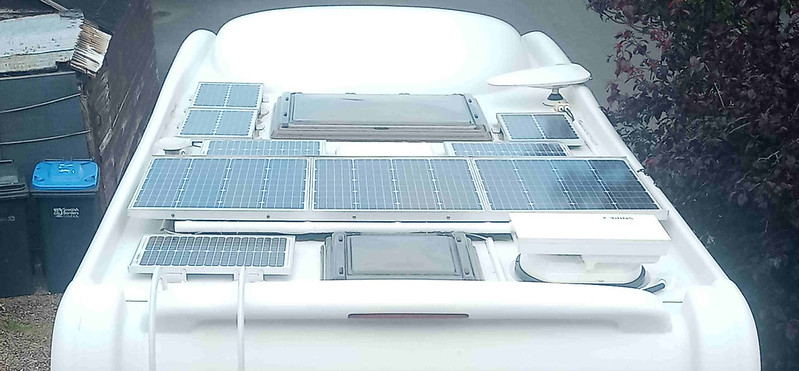
I've posted this photo a couple of times on different threads, but it might be of interest and relevance to your comment above?
On my Motorhome, the front part is a dome so nothing can be fitted on it (most vans with a overcab lump have an angled but flat section that can be used). Behind that I have a TV Aerial, a large skylight and 2 more smaller vents and a satellite dish, but choosing my panels carefully, I have covered all flat parts with PV Panels.

Monty-Roof
by David, on Flickr

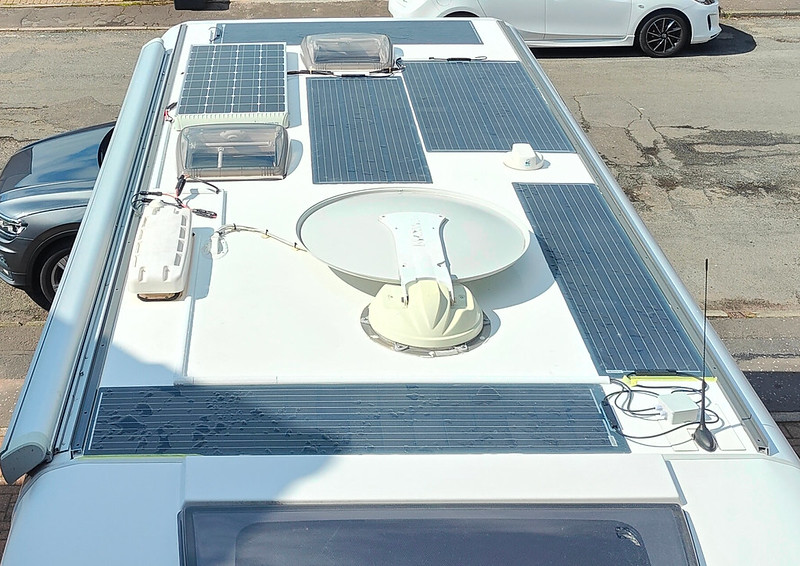
Since I did this, Photonic Universe has introduced a range of solar panels that are narrow and ultra-narrow and I selected various sized panels from that range to fill this Malibu roof with as much solar as possible while still accomodating a rather large satellite dish as well the roof skylights and fridge & heater vent.

Malibu - Front
by David, on Flickr

Both methods work well. Using the semi-flexible panel option gives a much neater option on a roof than the glass panels and for sure is the better option for a motorhome like that. On my Autotrail the side walls extend quite a few inches up from the roof so the multitude of solar panels cannot be seen unless you are above the van so in the case of a Motorhome like that, the appearance is not affected at all.

(Of course, to many, function is all and the asthetics are not a factor, but it is nice to have a smart looking solution IMO).
 
I've posted this photo a couple of times on different threads, but it might be of interest and relevance to your comment above?
On my Motorhome, the front part is a dome so nothing can be fitted on it (most vans with a overcab lump have an angled but flat section that can be used). Behind that I have a TV Aerial, a large skylight and 2 more smaller vents and a satellite dish, but choosing my panels carefully, I have covered all flat parts with PV Panels.

Monty-Roof by David, on Flickr

Since I did this, Photonic Universe has introduced a range of solar panels that are narrow and ultra-narrow and I selected various sized panels from that range to fill this Malibu roof with as much solar as possible while still accomodating a rather large satellite dish as well the roof skylights and fridge & heater vent.

Malibu - Front by David, on Flickr

Both methods work well. Using the semi-flexible panel option gives a much neater option on a roof than the glass panels and for sure is the better option for a motorhome like that. On my Autotrail the side walls extend quite a few inches up from the roof so the multitude of solar panels cannot be seen unless you are above the van so in the case of a Motorhome like that, the appearance is not affected at all.

(Of course, to many, function is all and the asthetics are not a factor, but it is nice to have a smart looking solution IMO).
That's interesting, I will take a look at the Photonic Universe SPs. Thanks for the tip.
 
My van spends time in storage with no EHU, the solar looks after the habitation batteries with no issue, but I also have a 45w roof mounted panel that looks after the starter battery via a small victron unit works very well. If its left for extended periods I also isolate the starter battery just to sure.
 
My (Eddie) Van Bitz Battery Master does pretty much the same thing.

I still pop into the storage compound when passing.
 
Returned from Spain on Friday after a 337 mile drive from the overnight stop on A491 Hagley Bypass, so both batteries were fully charged during the drive. 180w Solar Panel, Ablemail B2B + AMT 12-2 Trickle Charger has kept the batteries charged since then, with the Lithium reaching Float each day, in the Winter Sun. David@wildebus will be fiting an additional 120w Roof Solar Panel + replacement 320Ah Lithium [backed up by a Portable Panel] after our experience in Spain in December where the constant rain, very limited solar harvest + a greater need for battery power during the dark days meant that we couldn't hammer the lithium today and be certain that tomorrow would give us enough solar harvest to replenish the battery. The new set up should enable us to top up from a higher overnight SoC each day to avoid the need for exhortations a la Warden Hodges to 'put that light out!' :ROFLMAO:

Driving off with a drop down bed stuck at neck height until the Lithium has been fed is a step too far ... On sunny days the existing 180w Solar + 230Ah Lithium is perfectly adequate - the struggle is when the available light doesn't get beyond the 'bright as a glow worm's armpit' threshold ...

Steve
 
I thought that drop down beds had a hand cranked up/down thread should the battery fail, Steve?
They do, but cranking 200+kg with a 12inch Allen Key attached to a 1.5 inch nylon wheel causes blisters in the fold between thumb and index finger if you have to lower it manually. Trying to wind it up by hand is simply not feasible, say I having tried it for a few minutes before uttering the immortal or clichéd 'Sod this for a game of soldiers' expression!

The 'days of darkness' happened at Vilafranca del Penedes where we would normally spend 2 or 3 nights before moving on, either to its sister aire at Los Monjos, or to another area entirely. However, Vilafranca flooded and everybody stayed put until the mud and water levels reduced to 'just very soggy' and we were amongst the first to leave after 8 nights, by which stage the Lithium peak power had staggered back up to 13,05v, dropping to 12.8v/12.9v immediately after the bed raising; the User Manual says 'at 12.8v resting, you should get the battery charged as soon as possible ...'

It took about a week for a combination of driving every other day and a slight improvement in daylight quality and quantity to get to 13.2v, 13,28v and eventually 13.35v before we could relax and return to using the battery to power the bed, lights and Truma heating fan ...

Steve
 
Thanks for your kind reply explaining what can happen in the real World, Steve. You already own a decent set of batteries (about to be improved further.)

I remember visiting the Motorhome Show many years ago where the French manufacturer enthused about the system, but didn't want me to touch it myself. I left wondering what might happen when the weather is consistently poor.

I sincerely hope that your latest update resolves it for you both. 👍
 
They do, but cranking 200+kg with a 12inch Allen Key attached to a 1.5 inch nylon wheel causes blisters in the fold between thumb and index finger if you have to lower it manually. Trying to wind it up by hand is simply not feasible, say I having tried it for a few minutes before uttering the immortal or clichéd 'Sod this for a game of soldiers' expression!

The 'days of darkness' happened at Vilafranca del Penedes where we would normally spend 2 or 3 nights before moving on, either to its sister aire at Los Monjos, or to another area entirely. However, Vilafranca flooded and everybody stayed put until the mud and water levels reduced to 'just very soggy' and we were amongst the first to leave after 8 nights, by which stage the Lithium peak power had staggered back up to 13,05v, dropping to 12.8v/12.9v immediately after the bed raising; the User Manual says 'at 12.8v resting, you should get the battery charged as soon as possible ...'

It took about a week for a combination of driving every other day and a slight improvement in daylight quality and quantity to get to 13.2v, 13,28v and eventually 13.35v before we could relax and return to using the battery to power the bed, lights and Truma heating fan ...

Steve
Steve,
Remind me next week about this hand-cranking... Be interesting to see how well this works using an impact wrench or drill?

200Kg+? Are you lying on the bed when trying to lower it? :D
 
I've had a look but can only see a facility to use cab battery when hab is low, which isnt really a wise idea.
Can't see anything to swop charge to cab battery from hab battery.
 
Steve,
Remind me next week about this hand-cranking... Be interesting to see how well this works using an impact wrench or drill?

200Kg+? Are you lying on the bed when trying to lower it? :D
A 1/2" ratchet with suitable alen key socket would surely work a lot easier and more comfortable on the hands?
 
Back
Top