Some electrics advice please.

I always try to stop using power when the voltage is below 12.2 to preserve the battery life.
Although there is some merit in this cautious approach, you cannot assess the state of charge of a lead acid battery from the terminal voltage unless one hard-to-achieve condition is met: there has to have been no current into or out of the battery for at least 20 minutes.

If you draw a current, it will lower the battery voltage. The higher the current is as a proportion of the storage capacity of the battery, the bigger the voltage drop. The power takes some time to trickle up to.the surface of the plates.

If you put a middling load on the battery until it goes down to 12.2v, then let it rest for half an hour, the voltage will rise to well over 12.2. That higher reading is a better indicator of the state of charge (after adjusting for temperature).
 
Having read all the feedback through again I've deduced that my plan will not be any good to install a Lithium battery as Geek advised

If you add an extra battery without connecting it to the habitation wiring, yes, you could charge it with a B2B charger.

However, you would end up with a useless, fully charged battery by doing that. No wires to take the power anywhere useful.

If you connect the habitation wiring to it so you can use the power stored in it, you are also connecting it to the existing aux batteries.

That means that the output of the split charge relay and the output of the B2B charger will be joined together as soon as you start the engine. This will not end well.
As it won't end well.

I guess I will just buy another pair of EFB batteries unless anyone can advise how I can get a 150AH Lithium installed and charging from the alternator without any bad endings.

Thanks.

Pete

PS sadly and sorry I'm not too good at presenting things on forums.
 
You still haven't really clarified (in my mind) what you want to achieve.
I think this is what you have at present:
A starter battery, and a second battery which is wired in parallel with a third battery that was added later.
The second and third batteries are permanently wired together and power the habitation electrics as well as heated windscreens.
You say that when you removed the second battery the heated screens stopped working. This puzzles me.
They are connected to the starter battery when the engine is running, using a split charge relay arrangement, so the absence of the second battery shouldn't matter as soon as the engine starts. The circuits are all connected anyway.

What you want is almost exactly the same as you have, but you want more power stored in the auxiliary batteries.

If you replace the second and third batteries with one or more large batteries, that will do the job. The only trouble is that you would really have to replace the split charge relay with a B2B charger.

Adding the B2B is an expense, of course, and it will need a little installation. Removing the split charge relay should be a very simple task in comparison.
Not removing the SCR when adding a B2B is the thing that will not end well.
 
Don't mix lithium batteries together with lead acid batteries as auxiliary batteries.

Remove the two auxiliary batteries you have now and replace them with the lithium battery/s

Use the Victron B2B instead of the relay that connects the starter battery to the auxiliary batteries currently.

I would recommend replacing the old solar controller with the Victron solar controller, especially if you are thinking of adding more solar in the future.

How much driving do you do? Consider if you actually need the 50amp B2B, it would fully charge a 150ah lithium battery in 3 hour from fully depleated. Maybe a 30amp would be more suitable and cheaper to purchase. Just something to think about.

Regards Dave
 
Don't mix lithium batteries together with lead acid batteries as auxiliary batteries.
I have been doing this for several years. It has worked well for me, though it isn't a recommended setup.
I would recommend replacing the old solar controller with the Victron solar controller, especially if you are thinking of adding more solar in the future.
Change the controller at that point, if needed. Why sooner?
How much driving do you do? Consider if you actually need the 50amp B2B, it would fully charge a 150ah lithium battery in 3 hour from fully depleated. Maybe a 30amp would be more suitable and cheaper to purchase. Just something to think about.
It really doesn’t work like that. You can't recharge an empty 150Ah battery with a 50A B2B in three hours: it takes about 50% longer in real world conditions.
Also, almost nobody drives for three hours every day or two. Yes, maybe once at the beginning and end of a trip, but not day to day.

If you have a powerful alternator (it's good not to overheat the alternator with more than 50% load for hours on end), but otherwise it makes good sense to have a powerful B2B.
 
150Ah battery with a 50A B2B in three hours: it takes about 50% longer in real world conditions.
Also, almost nobody drives for three hours every day or two. Yes, maybe once at the beginning and end of a trip, but not day to day
Yes but I find it rare to fully depleat the battery anyway and especially If you are driving daily
 
Thanks again Geek you are very patient indeed.

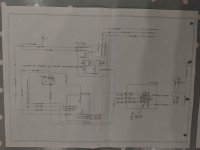
I have always been and still am confused with the intention of the Ford set up considering it's an 'option'. The second battery is sometimes referred to, by them, as ; Main Battery, Aux Battery, Deep Cycle Battery or Non Start Relevant Battery. What I see as the only SCR in the vehicle is sometimes called ; Battery Disconnect Switch or Charge relay or Split Charge Relay. This switch has 6 terminals ; the two 190A battery heavy duty contacts, then 2 coil connections, then a pull in and a pull out.
This item, I'll refer to as 'SCR' is well and truly integrated into several more functions than, what I normally would have expected of an SCR to be involved in. It is also very well buried, into the most inaccessible region of the very full, drivers seat base. If I can only achieve my aim by getting to this SCR and working into the wiring of it, as seems to be the case, I think I'll likely give up on my plans to be honest. Apart from having to completely strip out the whole seat base I would be concerned about messing up the functions of all the other things reliant upon it, not simply just disconnecting the battery + posts when the ignition is off/engine stopped. Even Battery logic on and off is in there amongst it heated screens etc ! 😥

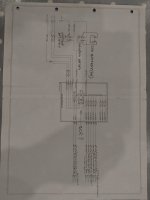
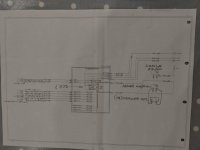
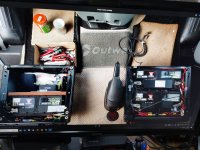
I'm going to try to include 4 photos of all the Ford Drawings I have and a picture of the two front seat bases so you may be able to see what I mean. I have marked in rough pencil on one of them where I connected the third battery and where Autosleepers connected their habitation equipment wiring directly to the second battery rather than using the fused customer connection terminals provided by Ford. The photo shows the drivers seat base with the starter battery and the 'second' battery basically as factory built, and in the passenger seat base the third battery I added in Parallel and the Morningstar Solar controller I put in years ago.

As I've said the whole thing has worked flawlessly (the second and third batteries replaced on a couple of occasions, now due) for almost 19 years I think. The only trouble I've found is the power available when sunlight is short is a bit skinny, plus a much shorter battery life than Lithium. I'd really like to have all the benefits of Lithium but it just seems too difficult though the costs of the battery and a B to B and maybe a new MPPT don't concern me. It's just that having to poke around in all that mysterious Ford stuff with the canbus watching me that I think is beyond my abilities now at a creaky old 78 !

There again as you said I could replace the second battery with a bigger one (Lithium) and a B to B, would I just have to get to the two battery connections of the Ford SCR and insert the B to B between them ? But surely the Ford stuff would be upset to find a Lithium battery where it previously had an EFB lead acid type, or something else to upset it, would it ?

I still think a 150AH Lithium (so back to two batteries total instead of three again in this case) would be sufficient for me with the much more usable capacity of the Lithium Technology.


Maybe I should just tough up and get on with it.

Very many thanks for all your time and patience.

Pete

IMG_20260114_150247430.jpgIMG_20260114_150454263_BURST000_COVER.jpgIMG_20260114_150247430.jpgIMG_20260114_150223641.jpgIMG_20260114_153342727_BURST000_COVER.jpg
 
Those pictures are no good on my phone. I'll look at them on a laptop later on.
One other thing to consider: one big battery might be harder to find space for and more difficult to handle than two smaller batteries. I have a really good AGM deep cycle battery, but it weighs 75KG. I'd not have bought it if it wasn't such a bargain.
 
I can't help wondering whether you couldn't get a higher capacity LiFePo4 battery under the passenger seat. Yes, 150Ah gives you more useable capacity than you currently have, but when making the investment, it might be preferable to maximise the capacity. The LifePo4 can be installed on its side, affording greater flexibility in fitting it in. @wildebus might have some ideas on this.
 
But surely the Ford stuff would be upset to find a Lithium battery where it previously had an EFB lead acid type, or something else to upset it, would it ?
No, vehicle electronics has to be pretty resilient.
The voltage of a 12v battery in a vehicle routinely varies between 11.5v and 15.4v with huge transient spikes in addition.

Going from a battery that sits at 12.7v to one that sits at 13.2v won't bother anything. Won't even notice.

On my system, there is 340Ah (well, it was when they were new, probably less now) of AGM battery connected to 100Ah of lithium battery, all charged and discharged as a single item.

The primary reason you need a B2B with a lithium battery is to protect the alternator: a lithium battery can draw so much current that it overheats the alternator.
 
I can't help wondering whether you couldn't get a higher capacity LiFePo4 battery under the passenger seat. Yes, 150Ah gives you more useable capacity than you currently have, but when making the investment, it might be preferable to maximise the capacity. The LifePo4 can be installed on its side, affording greater flexibility in fitting it in. @wildebus might have some ideas on this.
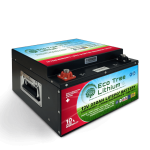
Yes thanks for that I just found a 230AH Lithium that could go under the passenger seat then ditch the second Ford Battery under the drivers seat and use that space for the B to B and solar regulator. If having a Lithium second battery in exchange for the Ford EFB and I can pluck up the courage to get at the Ford SCR. Expensive but exciting to have 230AH available. Thanks TJBiRS-12V-230AH-UNDERSEAT-Lithium-Leisure-Battery-LiFePO4-2-icons.png
 
No, vehicle electronics has to be pretty resilient.
The voltage of a 12v battery in a vehicle routinely varies between 11.5v and 15.4v with huge transient spikes in addition.

Going from a battery that sits at 12.7v to one that sits at 13.2v won't bother anything. Won't even notice.

On my system, there is 340Ah (well, it was when they were new, probably less now) of AGM battery connected to 100Ah of lithium battery, all charged and discharged as a single item.

The primary reason you need a B2B with a lithium battery is to protect the alternator: a lithium battery can draw so much current that it overheats the alternator.
That sounds good, thank you. So all I need to do is get the Lithium battery and the B to B. Then remove the Ford second battery and where it was connected to the SCR ( the Ford switch) insert the B to B is that correct ? Sorry I'm so slow I think I'm getting there slowly.

I found a 230 AH Lithium that would fit under the passenger seat and I could then use the vacated space under the drivers seat for the B to B and the solar controller. I think I could manage that when it gets a bit warmer. Not cheap but would do me for the rest of my life I think. 👌
 
Don't mix lithium batteries together with lead acid batteries as auxiliary batteries.

Remove the two auxiliary batteries you have now and replace them with the lithium battery/s

Use the Victron B2B instead of the relay that connects the starter battery to the auxiliary batteries currently.

I would recommend replacing the old solar controller with the Victron solar controller, especially if you are thinking of adding more solar in the future.

How much driving do you do? Consider if you actually need the 50amp B2B, it would fully charge a 150ah lithium battery in 3 hour from fully depleated. Maybe a 30amp would be more suitable and cheaper to purchase. Just something to think about.

Regards Dave
Thank you for contributing Dave. I don't drive every day usually a longish drive then no driving for up to 2 weeks then a longish drive home again. I think I will get a new Victron Solar Controller as the Morningstar must be 17 or 18 years old now and is limited to 15 A
 
Looking at those diagrams, it appears to be wired as a split charge relay that you switch on or off manually. Unfortunately, I found the later wiring diagrams quite hard to read. Being upside down didn't help.

You wrote "Autosleepers seized on this and used it as a leisure battery and just connected their leisure control panel and the Eberspacher heater to it." How feasible would it be to take their connections off it and fit them to your new, big battery instead?

That way, you isolate the first and second batteries from the habitation wiring, leaving the existing two batteries as 'starter' and 'spare starter' and not meddling with the bistable split charge relay..

Add one or more new batteries of your preferred size and type, maintained by a new B2B charger - and your existing solar controller (unless you have more solar panels that it can handle).

That just depends on being able to separate out the Autosleepers power feed from battery 2 and attach it to the new battery 3 instead.
 
Looking at those diagrams, it appears to be wired as a split charge relay that you switch on or off manually. Unfortunately, I found the later wiring diagrams quite hard to read. Being upside down didn't help.

You wrote "Autosleepers seized on this and used it as a leisure battery and just connected their leisure control panel and the Eberspacher heater to it." How feasible would it be to take their connections off it and fit them to your new, big battery instead?

That way, you isolate the first and second batteries from the habitation wiring, leaving the existing two batteries as 'starter' and 'spare starter' and not meddling with the bistable split charge relay..

Add one or more new batteries of your preferred size and type, maintained by a new B2B charger - and your existing solar controller (unless you have more solar panels that it can handle).

That just depends on being able to separate out the Autosleepers power feed from battery 2 and attach it to the new battery 3 instead.
Yes it is very easy for me to remove the habitation wiring from the second battery and connect it anywhere else, basically it's just a live feed and ground to the control panel from where it is fused and distributed ; lights, loo, hob ignitor,water pump, gauges etc, another wire for the Eberspacher heater and the fridge and it's relay. Just 4 wires.

The SCR is switched by the ignition and is a power to on plus power to off like a latching relay so bistable. It will stay where it is if there no power to either on or off in other words. (For whatever reason I don't know)

To be able to have the BIG new battery I would need the space to be made available by removing and ditching both the Ford second battery and the third one that I fitted to begin with.

So that would be the original starter battery and the big new one (possibly 230AH) plus a new B to B connected through the original Ford SCR, (or whatever they've calling it today). It's not voltage sensitive I'm sure just more complex with 6 terminals than a standard SCR with just 4. For whatever reason only Ford will know 🤔 I'm happy to do all that taking my time the end result would be fantastic for me for as long as I'll be driving.

I'm sorry the drawings aren't clear I'm not good at dealing with that sort of issue. Should I try again ?

Thanks again.

Peter
 
I think we know enough of it now. No need to try again.
Consider other places you might want the extra batteries. Under the seats is out of the way, but not all that convenient for access.
 
Yes it is very easy for me to remove the habitation wiring from the second battery and connect it anywhere else, basically it's just a live feed and ground to the control panel from where it is fused and distributed ; lights, loo, hob ignitor,water pump, gauges etc, another wire for the Eberspacher heater and the fridge and it's relay. Just 4 wires.

The SCR is switched by the ignition and is a power to on plus power to off like a latching relay so bistable. It will stay where it is if there no power to either on or off in other words. (For whatever reason I don't know)

To be able to have the BIG new battery I would need the space to be made available by removing and ditching both the Ford second battery and the third one that I fitted to begin with.

So that would be the original starter battery and the big new one (possibly 230AH) plus a new B to B connected through the original Ford SCR, (or whatever they've calling it today). It's not voltage sensitive I'm sure just more complex with 6 terminals than a standard SCR with just 4. For whatever reason only Ford will know 🤔 I'm happy to do all that taking my time the end result would be fantastic for me for as long as I'll be driving.

I'm sorry the drawings aren't clear I'm not good at dealing with that sort of issue. Should I try again ?

Thanks again.

Peter
Hi Peter, seems that you've got things sorted in your head now, if I may add a couple of details.
A lot of modern B2Bs including Victron use voltage sensing on the input to detect when the engine is running and then commence operating, in which case you can dispense with the weird Ford Latching relay SCR altogether, just wire the B2B directly to the starter battery. You may actually find that after you've removed battery 2 that you've got space to fit the B2B AND a small LFP battery in the space? Maybe 50Ah? maybe even 100Ah because some 100Ah lithiums are actually pretty small now and don't forget that if you followed the '50% rule' WRT discharging your LA batteries then you'll effective double your storage with LFP anyway.
Finally your old battery capacity monitor/display (assuming you've got one somewhere) will be next to useless with LFP and not accurate at all so consider adding a shunt style capacity monitor.
 
Back
Top